Turning ED Time Studies Into Reimbursement That Holds Up

Manual ED Time Studies Lead to Inaccurate Reimbursement Data
Little Colorado Medical Center first turned to VersaBadge to address a familiar challenge for Critical Access Hospitals: accurately capturing ED provider standby time without placing more work on an already lean finance team.
Manual time studies relied on ward clerks estimating provider time by hand, often rounding to the nearest 15 or 30 minutes regardless of what actually happened. The hospital's EMR didn't capture the level of detail the CMS cost report required either, so the finance team was left re-entering everything by hand each month, a process that was slow and left plenty of room for error.
LCMC needed an automated time study solution that could produce data accurate enough to defend under audit, without adding administrative burden. VersaBadge solved that challenge, and the return outpaced what the hospital had projected going in.
Serving the Navajo and Hopi Nations as a Primary Source of Care
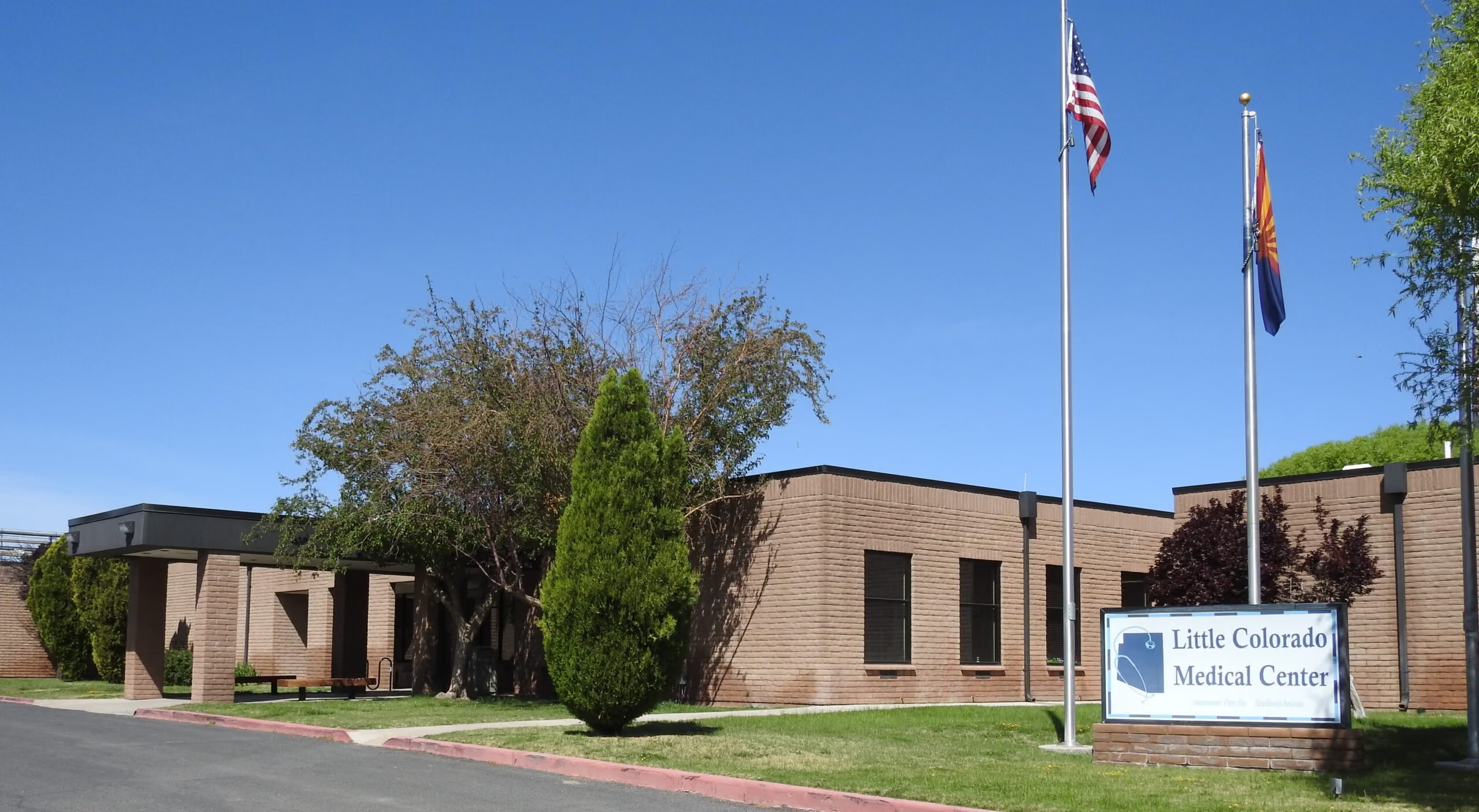
Little Colorado Medical Center is a 25-bed, not-for-profit Critical Access Hospital in Winslow, Arizona, about 50 miles east of Flagstaff. It's the primary source of inpatient and outpatient care for more than 32,000 residents across northeast Arizona, working in close partnership with the Winslow Indian Healthcare Center and in affiliation with Flagstaff Medical Center. Between 70 and 75% of LCMC's patients come from the Navajo and Hopi Nations, a relationship the hospital's leadership considers unmatched among Critical Access Hospitals in the state.
With Medicaid and Medicare making up a large share of the payer mix, reimbursement accuracy carries outsized weight here. The additional reimbursement LCMC recaptured through VersaBadge has helped fund real expansions in patient care, including a new MRI, with women's health services under consideration as a future service line.
Reimbursement Data the Board Can Trust
Automated Time Studies, Built Around Little Colorado's Reality
VersaBadge uses small Bluetooth receivers and lightweight staff badges to track provider location and automatically calculate standby time, without asking clinicians to change how they work. For LCMC, that meant replacing a manual, error-prone spreadsheet process with continuous, automatic tracking of ED provider standby time: the kind of defensible documentation cost-based reimbursement depends on.
Implementation required minimal IT involvement, even for a hospital where staff routinely wear multiple hats. The full rollout took roughly as much staff time as one month of the old manual process used to take, and by the finance team's own account, it was one of the smoothest technology implementations they've been through.

Receivers

Staff Badges
Little Colorado Medical Center Client Spotlight
A conversation with Lona King, CFO, on how VersaBadge helped a Critical Access Hospital serving the Navajo and Hopi Nations improve reimbursement accuracy, and what she'd tell any CFO still on the fence.